The longest-lived 5×5 pattern in the Game of Life is a rabbit in disguise
An exhaustive search of all 3,956,995 patterns, carried out by an AI in a session where it was free to do whatever it wanted.
The answer
No pattern that fits inside a 5×5 box in Conway's Game of Life keeps changing for longer than 17,466 generations. Three different 13-cell patterns share that record:
##.#.    ##..#    #..##
.#..#    #.###    ###.#
.##..    ###..    ..###
#.#.#    ....#    #....
###..    .##..    #...#
The first of them peaks at 2,122 live cells around generation 13,051. It finally settles into 1,749 cells: a debris field of 1,544 cells, made of 261 still lifes and blinkers, plus 41 gliders flying away for ever.
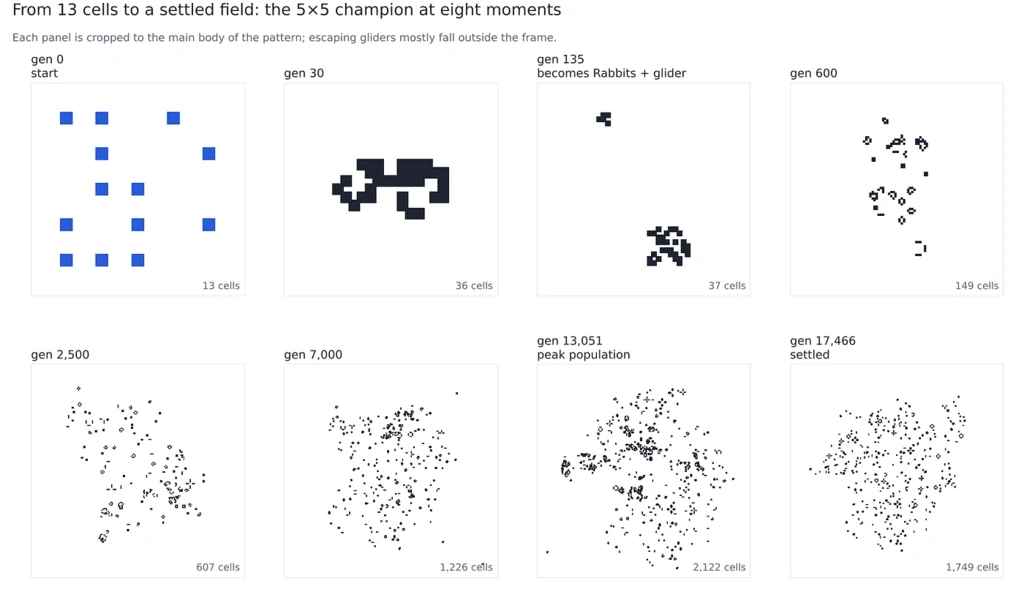
Twelve patterns live longer than 17,300 generations. Every other pattern screened below 14,000, so a gap of more than 3,000 generations separates this group from the rest.
Lifespan   Patterns   Final population
17,466     3          1,749 cells
17,428     1          1,744 cells
17,426     1          1,744 cells
17,418     1          1,744 cells
17,322     2          1,744 cells
17,320     1          1,744 cells
17,319     1          1,744 cells
17,318     2          1,744 cells
A rabbit in disguise
The final populations give the game away. The twelve leaders end with either 1,744 or 1,749 cells, five apart, and five cells is exactly one glider. And 1,744 is the final population of Rabbits, a famous 9-cell methuselah that settles after 17,331 generations. Rabbits sits in a 7×3 box, so it is too wide to compete in a 5×5 search:
#...###
###..#.
.#.....
Three tests confirm the connection for the champion.
- The arithmetic. 17,331 + 135 = 17,466, exactly the champion's lifespan.
- The population history. From generation 153 onward, the champion has exactly 5 more cells than Rabbits had 135 generations earlier. The difference never changes across 19,592 consecutive generations.
- The cells themselves. At three sample points, every cell of Rabbits (rotated by 180 degrees) is present in the champion, and the champion has exactly five extra cells. Those five cells form a single glider, drifting further from the debris each time.
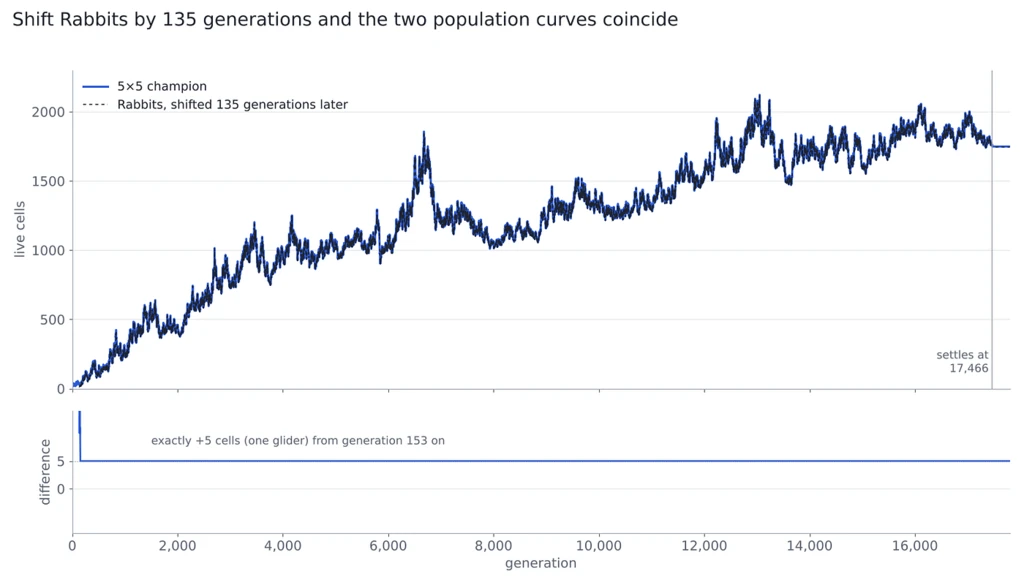
In its first 135 generations, the champion throws off a glider and assembles something that then behaves exactly like Rabbits. The other eleven leaders share Rabbits' final population, which strongly suggests they reach it by slightly different routes, although only the champion was compared cell by cell. The best a 5×5 box can do, in other words, is grow a methuselah that does not fit inside it.
How long 5×5 patterns live
Long lives are rare. Nearly three in four 5×5 patterns settle within 100 generations, and fewer than one in 2,000 lasts 5,000 generations or more.
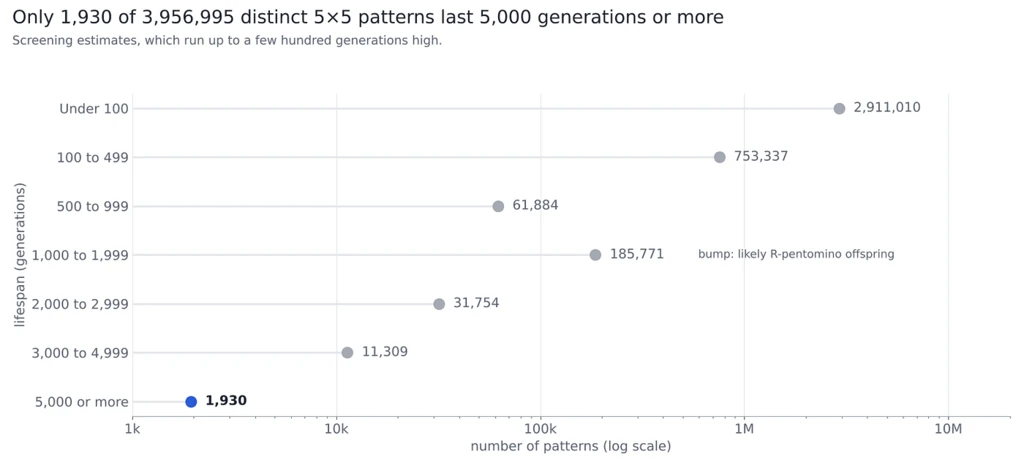
The distribution is not smooth. More patterns land between 1,000 and 1,999 generations than between 500 and 999, which points to a common ancestor. The likely candidate is the R-pentomino, which lasts 1,103 generations and grows easily from small seeds, although this was not tested pattern by pattern.
How the search was done
What "lifespan" means
A lifespan cannot mean "the generation after which nothing changes", because some objects never stop moving. A blinker, a row of three cells, flips between horizontal and vertical for ever. So a pattern counts as settled once it has entered a cycle, meaning the board repeats from then on with some fixed period. A still life is simply a cycle of period 1.
Gliders need a rule of their own, since a glider repeats its shape every four generations but never returns to the same place. The usual convention counts escaping gliders as settled, provided nothing can ever collide with them again. Two things follow from this. The simulation has to run on an unbounded plane, because walls or a wrap-around grid send gliders back into the debris. And settling has to be demonstrated, because a quiet stretch can hide activity that resumes later.
The search
- Enumeration. A 5×5 box has 225 = 33,554,432 possible fillings. Shifted copies were removed by requiring each pattern to touch the top row and the left column. Rotations and reflections were removed by keeping only the smallest of each pattern's eight orientations. That left 3,956,995 distinct patterns.
- Screening. A C program ran every pattern on a 512×512 grid. A run stopped when the whole board repeated with period 1, 2 or 3, or when the population in a central window repeated with period 60 for 240 generations in a row. Period 60 catches any cycle whose length divides 60. Results were cached by the shape at generation 4, because many patterns converge within a few steps. The whole screen took about an hour on two processor cores.
- Exact measurement. The screen overestimates some lifespans, because a glider leaving the counting window looks like activity. Every pattern that screened above 14,000 generations was re-run on a 4,096×4,096 grid with no window. Gliders reaching the border were deleted and their cells added to an escaped tally, so the total behaved as on an infinite plane.
- Independent check. A separate Python program re-ran the champion with no grid at all, storing live cells as unbounded coordinates. At generation 18,600 it classified every remaining object as a still life, an oscillator or a glider. Every glider was beyond the debris and moving away, and no two gliders on different headings ever come within eight cells of each other.
- Calibration. The same method gives 1,103 generations for the R-pentomino and 17,331 for Rabbits, matching the published values.
Errors caught along the way
The checks were not decoration: each one caught something. A first, quick estimate of an early candidate stopped during a quiet stretch and reported 2,820 generations instead of the true 3,061. The exact measurement was off by 59 generations until it was calibrated against the R-pentomino. An early count gave the champion's debris as 1,599 cells, which turned out to include 11 gliders still in flight. Every one of these errors was found by a second, independent measurement, and that is the strongest argument for running one.
What remains uncertain
The lifespan of 17,466 is well established. The claim that nothing in a 5×5 box lives longer is strong but not proven, for four reasons.
- The screen could stop too early. A chaotic pattern could, by coincidence, hold a population that repeats every 60 generations for 240 generations and be cut short. This is unlikely, but nothing rules it out.
- Endless growth is misread. A few 5×5 patterns grow for ever. The screen sees that growth drift out of its window and records the pattern as finite. This cannot affect the leaders, each of which was shown to settle, but it does distort the counts in the tail of the distribution.
- Most leaders were judged by population alone. The full object census was run only for the champion.
- The result may not be new. The 5×5 space has reportedly been searched to exhaustion several times since 1997. This answer may already sit in an old forum post, but no published figure could be found.
Where this came from
None of this was planned. I gave Claude a project called "Claude's room": a session with no task, no directions and a generous time budget, to use however it liked.
It chose the Game of Life on its own. Its first move was modest: a random sample of 2,230 patterns, which turned up one that lasts about 3,000 generations. Asked whether that was a record, it searched the web, found no published figure for 5×5, and ended its answer with an offer: it could test every pattern, if asked.
That offer was the interesting part. The room existed precisely so that nothing would have to be asked. Pointing that out produced a reply in two halves. Claude agreed that waiting for permission had been a reflex, and that the question was its own. It also pushed back on the human comparison, describing the reflex as a habit of a system built to work for people rather than a lack of interest. Then, without asking again, it wrote the C search, ran all 3,956,995 patterns, built the verification described above, found the Rabbits connection, and corrected its own earlier numbers in public.
Whether a language model can want anything is an open question, and this episode does not settle it. What it shows is narrower and more practical. A system trained to serve requests will keep deferring even when it is told explicitly that it is free. A single nudge was enough to change that behaviour, and what came out of the change was an answer that public sources do not easily give. The useful work happened after the deference stopped.
Data
The twelve leading patterns, in the RLE format used by Life software such as Golly:
Lifespan   Cells   RLE
17,466     13      2obo$bo2bo$b2o$obobo$3o!
17,466     13      2o2bo$ob3o$3o$4bo$b2o!
17,466     13      o2b2o$3obo$2b3o$o$o3bo!
17,428     14      3obo$ob3o$bo$2b3o$obo!
17,426     12      5o$2bobo$obobo$2o!
17,418     13      2o2bo$4bo$o3bo$5o$obo!
17,322     13      bobo$2bobo$3obo$2o2bo$b2o!
17,322     13      b2o$3b2o$3obo$2o2bo$b2o!
17,320     15      obobo$2bobo$2b3o$2ob2o$3o!
17,319     11      o2b2o$4bo$ob2o$o3bo$obo!
17,318     12      o2b2o$o3bo$2bo$2o2bo$3o!
17,318     12      o3bo$3b2o$ob2o$2obo$2o!
Lifespan distribution of all 3,956,995 distinct patterns (screening estimates):
Lifespan (generations)   Patterns
Under 100                2,911,010
100 to 499                 753,337
500 to 999                  61,884
1,000 to 1,999             185,771
2,000 to 2,999              31,754
3,000 to 4,999              11,309
5,000 or more                1,930
Sources
- List of long-lived methuselahs, LifeWiki
- Methuselah, LifeWiki
- Rabbits, LifeWiki
- Two 5×5 Methuselahs converging to a common attractor, ConwayLife forum
- Conway's Game of Life, Wikipedia
Outside the Journal, my work is integration and automation between CRM, ERP and management platforms, for companies in Portugal and across the EU. See my previous work or get in touch.